Summer festivals and water parks in Korea
Korea's summer water parks and festivals, from Caribbean Bay in Yongin to Boryeong mud, Waterbomb and the Han River pools, with prices, transport and timing.
By Jae Park · Updated Jul 14, 2026
The first time Korean summer really landed for me, it wasn't on a beach. It was a Waterbomb clip: an idol on stage getting blasted point-blank with a fire hose while ten thousand people in soaked rash guards screamed the chorus back. I remember thinking, so this is what they do with the heat here. They don't hide from it. They weaponize it.
If you found Korea through K-drama, K-pop or a late-night bowl of ramyeon, summer is the season that will surprise you most. From late June the monsoon (장마, *jangma*) rolls in, then July and August turn into a wall of heat and humidity that regularly sits above 33°C with saturated air that makes it feel worse. The national response is water — enormous engineered water parks, mud fights on the beach, idol-fronted water festivals, and free riverside pools in the middle of Seoul. This guide walks through the ones worth your day, starting with the giant that started it all.
Caribbean Bay, Yongin: Korea's original water park
Caribbean Bay opened in 1996 as part of Samsung's Everland Resort in Yongin, about an hour south of Seoul. It was Korea's first proper water park, and for years it held the title of the world's largest with connected indoor and outdoor sections. Walk in today and the scale still shows — a Spanish-fort theme, palm trees that have no business being in Gyeonggi Province, and a wave pool that throws artificial waves up to 2.4 meters. That wave pool is where the crowd energy peaks; on a hot Saturday you'll be shoulder to shoulder with a few thousand people all bobbing and shrieking as the horn sounds.
Beyond the waves there's the Wild River rapids zone (a 2008 expansion that added about 30% capacity), a very long lazy river, body slides, a sandy pool, a wading area for small kids, and a salt sauna for when your fingers finally prune. In summer the park runs Water Music Pool Party sessions with DJs and live performances staged right at the wave pool — in 2026 those are scheduled roughly mid-June through early September, which is when the place feels most like a festival and least like a swim.
Pricing follows a season ladder rather than a flat rate, and this trips up a lot of visitors. The park opens in May at low-season prices, climbs through spring and early summer, then hits "Gold Season" from early July through late August when demand peaks. In Gold Season an all-day adult ticket runs around ₩70,000 and a child ticket around ₩55,000, with cheaper afternoon entry (from about 14:30) and night entry (from about 18:00) if you'd rather skip the midday sun. Shoulder-season days are noticeably lighter on the wallet. Hours are usually 10:00–18:00 for indoor areas and 10:00–17:00 outdoors, but they shift by date, so check the official Caribbean Bay page before you commit — prices and the season calendar move every year.
Getting there from Seoul is easier than the distance suggests. The simplest route is Bus 5002 from Gangnam Station (Line 2) Exit 5, a direct run of roughly 40–55 minutes depending on traffic, with buses every 10–15 minutes from early morning. If you prefer rail, ride to Giheung Station on the Bundang Line, transfer to the Yongin EverLine light rail to its last stop, Jeondae·Everland Station, then take the free shuttle to the resort gate — figure about 80 minutes end to end. Buy your park ticket online in advance; the gate lines in Gold Season are brutal, and online sellers often shave the price. Pack a rash guard, water shoes and a change of clothes, and bring a card or cash for lockers.
Ocean World: the bigger, brasher rival
If Caribbean Bay is the classic, Ocean World at Vivaldi Park in Hongcheon, Gangwon Province, is the challenger that took the crown for sheer size — it's now billed as Korea's largest water park. The theming leans hard into ancient Egypt, all sphinxes and pharaoh masks around the pools, which is exactly as fun and as slightly ridiculous as it sounds. The same resort becomes a ski hill in winter, so the infrastructure for busing city crowds up here is well oiled.
Standard gate prices sit around ₩60,000 for adults and ₩50,000 for children, but almost nobody pays full price. Foreign-visitor discounts of up to about 40% are common through Korean travel resellers, and the park often hands you a steep coupon for a return visit the next day. It's roughly 60–90 minutes from Seoul by car; without a car, the easiest path is a shuttle package or a day tour, since public transport out to Hongcheon is fiddly. I'd pick Ocean World if you're chasing slide count and don't mind a scene that skews younger and rowdier, and Caribbean Bay if you want the more polished, family-friendly original closer to the city.
Boryeong Mud Festival: skincare that turned into a brawl
Here's the origin story generic listicles skip. The Boryeong Mud Festival wasn't dreamed up as a party — it was a marketing campaign. In the mid-1990s, research by Professor Kim Jae-baek of Wonkwang University showed that the tidal-flat mud around Boryeong was unusually rich in bentonite and germanium, both linked to skin benefits. The city started making cosmetics from it, and in 1998 the first festival was staged at Daecheon Beach essentially to sell that mud to tourists. It worked far beyond anyone's plan. What began as a provincial cosmetics pitch now pulls in around two million visitors a year and has become the single most famous Korean summer event among foreign travelers.
The format is gloriously simple: giant mud pits, mud slides, mud wrestling, mud prison, and a self-massage zone, all a few steps from the sea so you can rinse off in the West Sea when you're fully coated. Evenings bring drone shows, live music and sometimes a Black Eagles aerobatic display over the beach. It runs for roughly two and a half weeks from mid-to-late July into early August each year — 2025's edition ran July 25 to August 10 as a reference point, but always confirm the current dates on the official Korea.net or Boryeong city listing before booking. Entry to the main mud zone has typically been around ₩10,000 on weekdays and ₩14,000 on weekends, cheaper if bought ahead.
Boryeong sits on the west coast in Chungcheongnam-do. From Seoul, take an intercity bus from the Central City / Express Bus Terminal to Boryeong (about 2.5 hours), or ride the Janghang Line train to Daecheon Station and hop a local bus to the beach. Go on a weekday if you can — weekends get shoulder-to-shoulder — and wear clothes and a phone case you don't mind sacrificing to the mud. For a full breakdown of what to pack and how the pits are laid out, our Boryeong Mud Festival guide goes deeper than I can here.
Waterbomb and the K-pop water festival
This is the one born directly from the culture that probably brought you here. Waterbomb is a music festival built around getting soaked — a stage, a lineup of K-pop idols, rappers and EDM DJs, and industrial-grade water cannons pointed at the crowd. Fans bring their own water guns. Artists shoot back. Performers get drenched mid-choreography, and the resulting clips are half the reason the festival is a phenomenon. Recent Seoul editions have run each July at KINTEX in Goyang, with sister editions traveling to Busan, Daegu, Sokcho, Gwangju and beyond across the summer. Lineups shift every year and skew big — past years have featured names like Jay Park, Zico, ITZY and Jessi.
A few honest warnings. Tickets sell fast and aren't cheap, the crowd is intense, and the water is genuinely relentless, so leave anything you care about in a locker or a proper waterproof pouch. If you're buying from outside Korea, the ticketing sites can be a maze of Korean-only checkout and local-payment quirks; our walkthrough on how to buy Korean performance tickets in English covers the workarounds. Waterbomb isn't the only summer festival worth your time, either — for something drier and guitar-driven, the Pentaport Rock Festival in Incheon is Korea's longest-running rock event.
Free and cheap: the Han River pools and city water fights
Not every summer day needs a ₩70,000 ticket. Seoul's best-value water is the Han River (한강) itself. Each summer the city opens outdoor swimming pools and water-play areas along the riverside parks — Ttukseom and Yeouido have the full pools, while Jamsil, Nanji, Yanghwa and Gwangnaru run water playgrounds. In 2026 they're open roughly June 19 to August 30, daily 09:00–18:00, with night swimming added at Ttukseom and Yeouido from early July. Admission is astonishingly low: about ₩5,000 for an adult at the swimming pools, ₩3,000 at the water-play areas, and free for children under six. You get changing rooms, rental tubes and a view of the bridges — it's where locals actually go, not a tourist trap.
Then there's the water-gun tradition. The Sinchon Water Gun Festival, first held in 2013 in the student district around Yonsei University, turned the main street into a soaking zone with slides and water cannons. Be warned that its scheduling has been irregular in recent years, sometimes moving venues or skipping a summer, so treat it as a "check close to the date" event rather than a fixture — the Seoul tourism site or the Seodaemun-gu district page will confirm whether it's running. The broader point stands: in a Korean summer, a ₩5,000 water gun from any convenience store is a legitimate activity.
The beaches, because summer isn't only pools
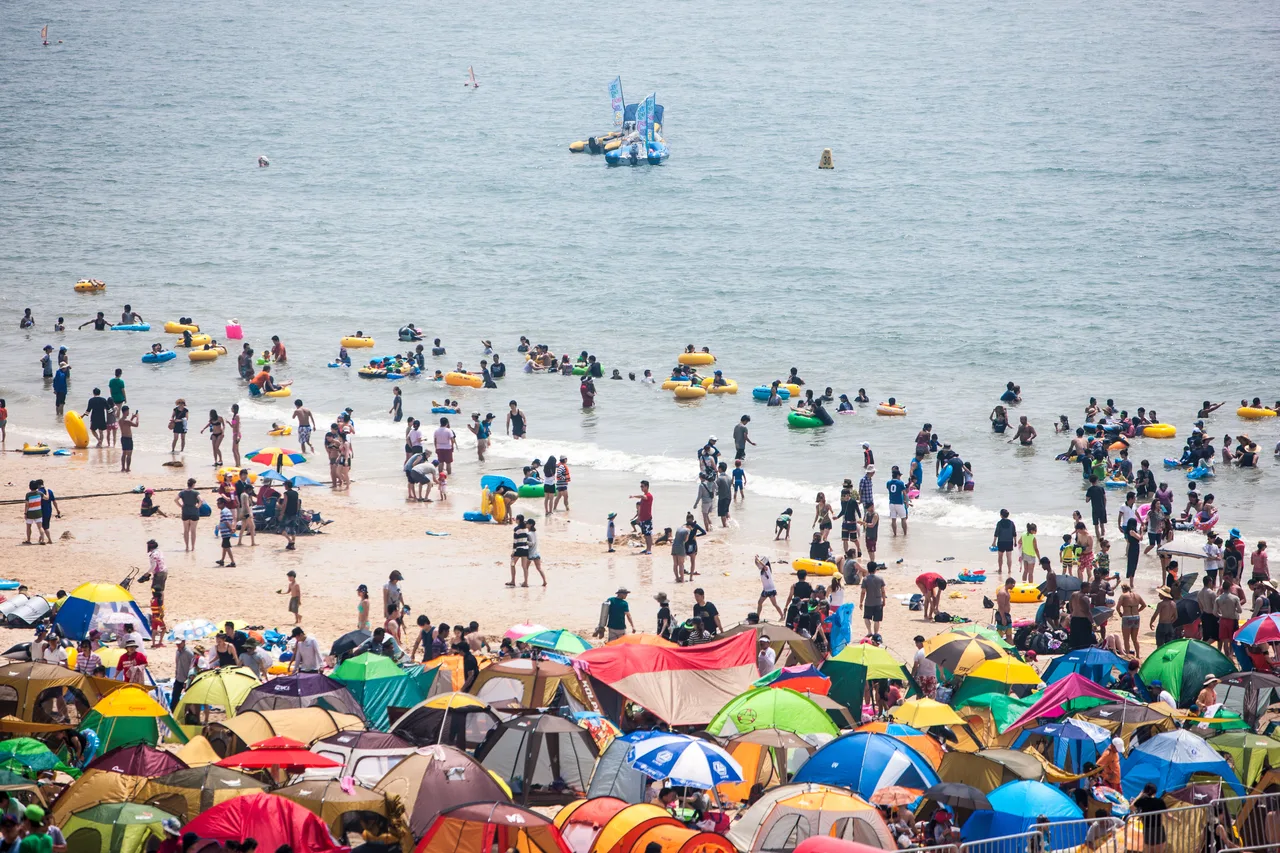
Koreans also do the ocean, and the coast is where a lot of K-drama summer episodes are shot. Busan's Haeundae (해운대) is the headline beach — a wide arc of sand backed by high-rises, packed with parasols in July and August, and the site of the Busan Sea Festival with concerts and beachside events at peak season. Gangneung and Sokcho on the east coast draw the Seoul crowd for clearer water and a slower pace, and both are reachable by the KTX-eum high-speed train in under two and a half hours. If you're chasing a specific drama scene rather than a swim, that's a different kind of trip, but the beaches double as filming backdrops constantly.
When to go and how to survive it
Timing matters more in summer than in any other Korean season. The monsoon usually runs from late June into late July, bringing heavy, unpredictable rain — outdoor festivals still happen in it (Boryeong is arguably better muddy and wet), but pack a cheap poncho. Once *jangma* lifts, the back half of July and all of August deliver the real heat, which is also when every water venue is most crowded and most expensive. If you can, aim for a weekday in the first half of July or the tail of August to dodge both the worst prices and the worst lines.
A few practical habits that saved me. Reserve water-park and festival tickets online before you arrive; walk-up prices are higher and Gold Season queues eat an hour. Reapply sunscreen far more often than you think — the humidity hides how much sun you're catching. Carry a waterproof phone case everywhere, because you will end up wetter than planned. And keep mobile data live for last-minute schedule and weather checks, since dates shift; if you haven't sorted connectivity, our SIM vs eSIM in Korea comparison lays out the cheapest options.
One last thing I'd tell a friend flying in: don't treat these as separate bucket-list stops to tick off. Stack them. Do a Han River pool morning, a Waterbomb night, a mud-caked weekend in Boryeong. The idols get blasted, the office workers float down the lazy river, the kids scream in the wave pool — and for three sweaty months, the whole country agrees that the only reasonable way through the heat is to get completely, deliberately soaked. Confirm every date and price on the official pages before you go, then go get wet.
Location
Caribbean Bay, Yongin
View on Google MapsSources
This guide was researched using the references below. Prices and times change, so confirm anything time-sensitive on the official page before you rely on it.
Related guides
- Jeju black pork: a guide for foreign visitorsDiscover Jeju's famed black pork: its history, unique flavor, and where to savor it on the island.
- Jeju car rental guide for foreignersA comprehensive guide for foreigners on renting a car in Jeju, covering requirements, costs, insurance, and driving tips.
- Jeju Island weather: what to expect each seasonA practical guide to Jeju Island's weather by season, helping you plan the best time to visit based on climate, activities, and crowd levels.
- Flying with Jeju Air: A guide for international travelersA comprehensive guide for international travelers on flying with Jeju Air, covering booking, baggage policies, check-in procedures, and seasonal travel tip
- Korea festivals in May 2026: A guide for visitorsExplore Korea's lively festivals in May 2026, from the dazzling Lotus Lantern Festival in Seoul to the fragrant Rose Festivals in Samcheok and Gokseong.
- Seoul Lantern Festival: what to know before you goSeoul's biggest winter light show runs free along the Cheonggyecheon stream downtown. Here is when it is held, how to reach it by subway, and what to see.